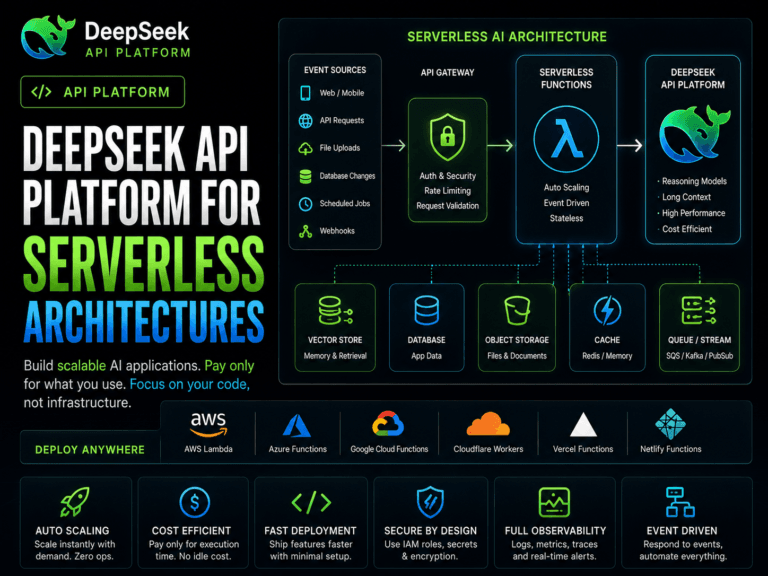

Artificial intelligence APIs are no longer experimental tools used only by large enterprises. Today, startups, SaaS companies, automation agencies, internal business teams, and independent developers rely on AI APIs to power customer support, coding assistants, AI agents, search systems, workflow automation, document analysis, and reasoning-heavy applications.
What Can You Build With the DeepSeek API Platform
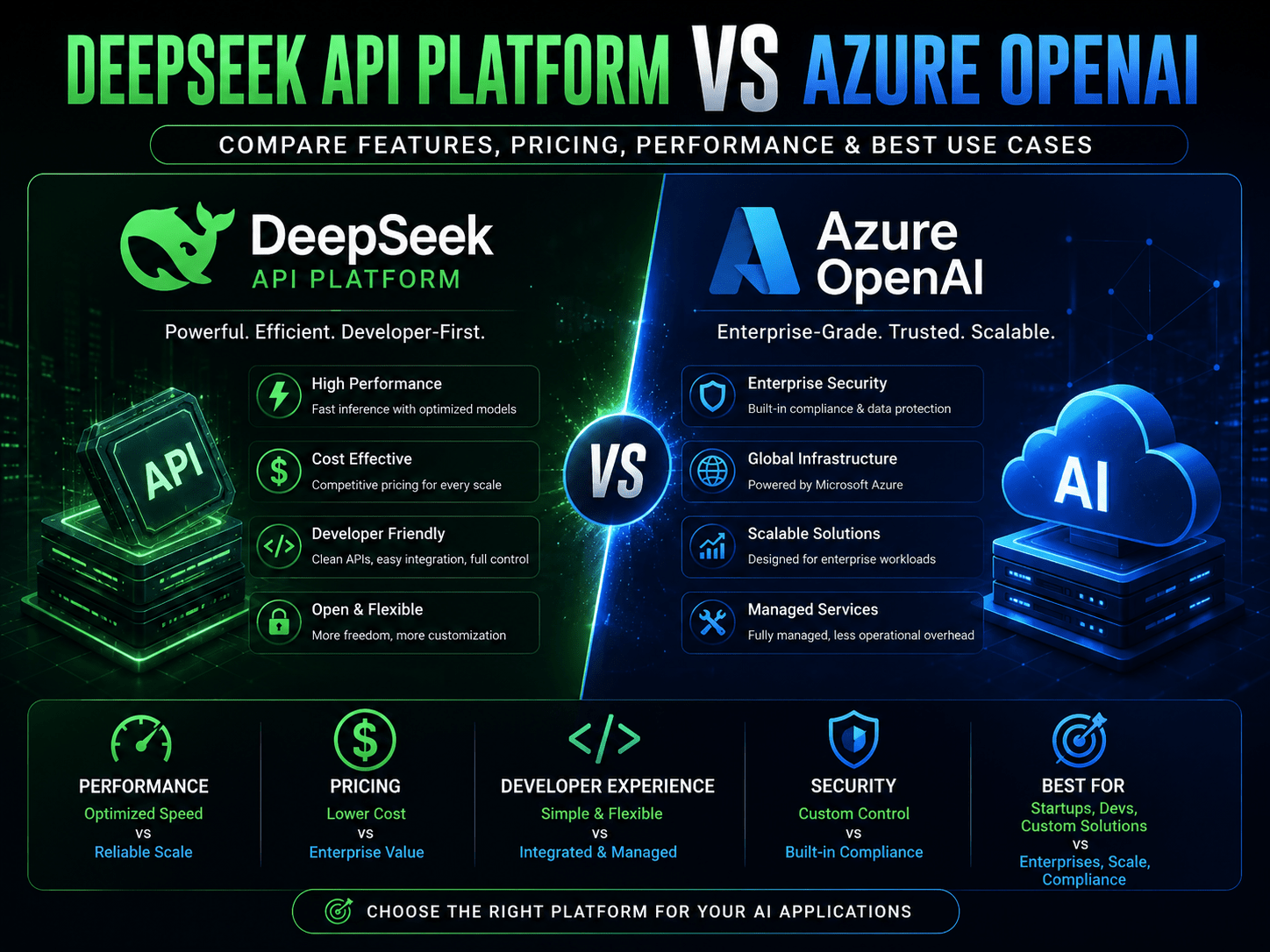
Two platforms that now appear frequently in technical evaluations are DeepSeek API Platform and Azure OpenAI.
At first glance, both platforms appear to solve similar problems:
- Access to advanced AI models
- API-based AI integration
- Scalable AI infrastructure
- Enterprise-ready deployments
- Support for production applications
But once teams start building real-world systems, the differences become much more obvious.
The platforms differ in:
- pricing structure
- deployment philosophy
- model ecosystem
- reasoning capabilities
- enterprise tooling
- latency consistency
- operational complexity
- compliance positioning
- developer experience
- and long-term flexibility
This guide breaks down DeepSeek API Platform vs Azure OpenAI from a practical engineering and business perspective.
Instead of marketing claims, we’ll focus on:
- where each platform performs well
- where each platform struggles
- real production trade-offs
- developer experience differences
- infrastructure considerations
- cost implications
- and which platform makes more sense depending on your use case
What Is DeepSeek API Platform?
DeepSeek API Platform provides API access to DeepSeek language models, reasoning models, coding models, and multimodal systems.
The platform has gained attention because it combines:
- relatively low pricing
- strong reasoning performance
- long-context support
- open-model ecosystem alignment
- developer-friendly experimentation
- and fast iteration cycles
Developers commonly use DeepSeek for:
- AI agents
- coding assistants
- automation pipelines
- backend AI workflows
- document analysis
- reasoning-heavy tasks
- long-context applications
- and cost-sensitive production deployments
One of the biggest reasons teams evaluate DeepSeek is economics.
Many companies discovered they could dramatically reduce AI operating costs compared to premium enterprise AI providers while still maintaining acceptable output quality.
That does not automatically make DeepSeek “better,” but it changes the evaluation process significantly.
Common API Errors and How to Solve Them (The DeepSeek Guide)
What Is Azure OpenAI?
Azure OpenAI is Microsoft’s enterprise AI platform that provides managed access to OpenAI models through Microsoft Azure infrastructure.
Instead of accessing OpenAI directly, organizations can deploy OpenAI models within Azure environments.
This creates several enterprise advantages:
- Azure ecosystem integration
- enterprise governance tooling
- compliance infrastructure
- regional deployment options
- private networking support
- enterprise authentication systems
- enterprise procurement compatibility
- and advanced security controls
Azure OpenAI is commonly used by:
- large enterprises
- regulated industries
- government contractors
- financial institutions
- healthcare organizations
- large SaaS providers
- and companies already deeply invested in Azure infrastructure
In many organizations, Azure OpenAI adoption happens because enterprise IT departments already trust Microsoft.
That trust matters more than raw model performance in many enterprise procurement decisions.
Core Philosophy Differences
Before comparing technical details, it’s important to understand the philosophical difference between the platforms.
DeepSeek API Platform Philosophy
DeepSeek generally focuses on:
- aggressive cost efficiency
- fast innovation
- open-model ecosystem momentum
- reasoning optimization
- developer accessibility
- and rapid experimentation
The platform feels closer to a modern AI-native developer platform.
It appeals strongly to:
- startups
- indie developers
- AI product teams
- automation engineers
- and fast-moving SaaS companies
Azure OpenAI Philosophy
Azure OpenAI focuses heavily on:
- enterprise governance
- compliance
- operational reliability
- identity management
- large-scale organizational deployment
- and infrastructure standardization
It is designed for organizations where:
- procurement matters
- compliance matters
- auditability matters
- legal reviews matter
- and enterprise integration matters
This difference affects almost every technical and operational decision.
Why Our API Platform is the Most Scalable Solution for Your Startup
Model Ecosystem Comparison
DeepSeek API Platform Models
DeepSeek provides access to multiple specialized models including:
- DeepSeek V3
- DeepSeek R1
- DeepSeek Coder
- DeepSeek VL
- reasoning-focused systems
- code-generation models
- multimodal models
This specialization can help developers choose models optimized for specific tasks.
For example:
- R1 for reasoning
- Coder for development workflows
- VL for multimodal tasks
- V3 for general-purpose generation
This creates more optimization flexibility.
Azure OpenAI Models
Azure OpenAI primarily provides managed access to OpenAI models such as:
- GPT-4
- GPT-4 Turbo
- GPT-4o
- embeddings models
- multimodal systems
- and enterprise deployment variants
The strength of Azure OpenAI is model maturity and ecosystem integration.
OpenAI models remain extremely strong in:
- conversational quality
- instruction following
- general reasoning
- tool usage
- broad ecosystem support
- and documentation maturity
However, Azure customers are still partially dependent on Microsoft’s deployment timelines and OpenAI release availability.
Pricing Differences
Pricing is one of the biggest reasons developers compare these platforms.
DeepSeek Pricing Advantage
DeepSeek is often dramatically cheaper for:
- token-heavy applications
- long-context systems
- AI agents
- batch processing
- high-volume automation
- and experimental AI workloads
This matters enormously for:
- startups
- bootstrapped SaaS tools
- AI experimentation
- internal tools
- and products with thin margins
Many teams discover that OpenAI-scale pricing becomes difficult once workloads scale.
DeepSeek can significantly reduce operational AI costs.
Unlocking Advanced Features: A Deep Dive into the DeepSeek API
Azure OpenAI Pricing Reality
Azure OpenAI pricing is usually higher.
But enterprise buyers are not only paying for tokens.
They are also paying for:
- enterprise infrastructure
- governance layers
- security controls
- compliance tooling
- regional deployments
- operational reliability
- and Azure ecosystem compatibility
For enterprises, reducing operational risk may matter more than lowering token costs.
That is why many large organizations still choose Azure OpenAI despite higher pricing.
Developer Experience Comparison
DeepSeek Developer Experience
DeepSeek generally provides a more lightweight and experimentation-friendly developer experience.
Developers often appreciate:
- faster onboarding
- fewer enterprise barriers
- simpler experimentation
- lower cost testing
- quick API iteration
- and flexible prototyping
For AI-native startups, this speed matters.
Teams can prototype quickly without navigating large enterprise infrastructure requirements.
Azure OpenAI Developer Experience
Azure OpenAI can feel more complex.
Developers frequently deal with:
- Azure resource configuration
- IAM policies
- enterprise authentication
- regional deployment setup
- quota management
- networking configuration
- and enterprise governance layers
This complexity exists because Azure OpenAI is designed for enterprise operational control.
For smaller teams, that complexity may feel excessive.
For enterprises, it may feel necessary.
Getting Started: Your First “Hello World” with the DeepSeek API Platform
Enterprise Security and Compliance
This is one of Azure OpenAI’s strongest areas.
Azure OpenAI Enterprise Advantages
Azure OpenAI offers:
- enterprise-grade identity systems
- Azure Active Directory integration
- private networking options
- compliance certifications
- enterprise governance controls
- auditability
- policy management
- and regional infrastructure choices
This matters heavily in:
- healthcare
- finance
- government
- insurance
- and regulated enterprise sectors
In some industries, these requirements are mandatory.
DeepSeek Enterprise Considerations
DeepSeek is improving rapidly, but many enterprises still evaluate it more cautiously.
Questions often arise around:
- governance maturity
- enterprise support
- compliance alignment
- regional deployment guarantees
- operational transparency
- and long-term enterprise ecosystem support
For startups and developers, these concerns may not matter much.
For enterprise legal teams, they matter a lot.
Performance and Latency
Performance comparisons depend heavily on workload type.
Where DeepSeek Often Performs Well
DeepSeek frequently performs strongly in:
- reasoning-heavy tasks
- code generation
- structured workflows
- cost-efficient automation
- long-context operations
- and analytical prompting
Many developers report strong performance-per-dollar ratios.
Where Azure OpenAI Often Performs Well
Azure OpenAI often performs strongly in:
- enterprise stability
- conversational polish
- infrastructure consistency
- tool ecosystems
- mature deployment pipelines
- and large organizational workflows
Latency consistency can also be stronger in enterprise-grade Azure deployments depending on region and provisioning configuration.
AI Agents and Workflow Automation
AI agents are becoming a major evaluation category.
DeepSeek for AI Agents
DeepSeek is attractive for AI agents because:
- reasoning costs are lower
- large context is affordable
- experimentation is cheaper
- iterative workflows cost less
- and scaling autonomous systems becomes financially realistic
This is especially important because AI agents generate massive token consumption.
Cost efficiency becomes critical.
Azure OpenAI for AI Agents
Azure OpenAI works well for enterprise-grade AI agents that require:
- governance
- security
- Azure integration
- enterprise workflows
- compliance monitoring
- and organizational oversight
Large enterprises building internal AI copilots often prefer Azure OpenAI because it integrates into broader Microsoft ecosystems.
Long-Context Applications
Long-context workloads are becoming increasingly important.
Examples include:
- document analysis
- legal processing
- research systems
- enterprise knowledge bases
- and large conversational memory systems
DeepSeek Long-Context Advantage
DeepSeek is often attractive here because long-context processing can become extremely expensive on premium enterprise APIs.
For teams processing:
- huge documents
- large retrieval pipelines
- or agent memory systems
DeepSeek’s pricing model can provide major cost savings.
Azure OpenAI Long-Context Trade-Off
Azure OpenAI supports long-context operations well, but costs may scale aggressively depending on workload size.
Large enterprises may still accept these costs for compliance and governance reasons.
Smaller companies often cannot.
Vendor Lock-In Considerations
Vendor lock-in is an important long-term concern.
Azure OpenAI Lock-In Risk
Azure OpenAI can create deeper ecosystem dependence because organizations often integrate:
- Azure identity systems
- Azure networking
- Azure monitoring
- Azure governance
- Azure storage
- and Microsoft enterprise tooling
This can make migration more difficult later.
DeepSeek Flexibility
DeepSeek often aligns more naturally with:
- open-model workflows
- modular AI architectures
- multi-model routing systems
- and experimental AI infrastructure
This can make architectural flexibility easier.
Which Platform Is Better for Startups?
For many startups, DeepSeek is extremely attractive because:
- lower costs reduce burn rate
- experimentation is cheaper
- scaling AI products becomes more realistic
- and operational overhead stays lower
Startups often prioritize:
- speed
- iteration
- cost efficiency
- and flexibility
DeepSeek aligns well with those priorities.
However, startups working in regulated industries may still require Azure OpenAI.
Which Platform Is Better for Enterprises?
For large enterprises, Azure OpenAI often remains the safer operational choice.
Reasons include:
- compliance alignment
- procurement familiarity
- Microsoft ecosystem integration
- enterprise governance
- security controls
- and legal comfort
In enterprise environments, organizational trust frequently matters more than token pricing.
Common Mistakes Teams Make During Evaluation
Many organizations compare these platforms incorrectly.
Mistake 1: Comparing Only Raw Model Quality
Infrastructure, governance, pricing, and operational requirements matter just as much as output quality.
Mistake 2: Ignoring Long-Term Token Economics
AI costs scale quickly.
A platform that seems affordable during prototyping may become extremely expensive at production scale.
Mistake 3: Underestimating Governance Complexity
Enterprise AI deployments involve:
- legal review
- audit requirements
- compliance reviews
- identity management
- and operational monitoring
Mistake 4: Choosing Based on Hype
The best platform depends entirely on:
- workload type
- organizational size
- budget
- compliance needs
- and engineering priorities
Real-World Decision Framework
Choose DeepSeek API Platform If:
- you are cost-sensitive
- you are building AI agents
- you need reasoning-heavy workloads
- you want rapid experimentation
- you are building startup-scale systems
- you prioritize flexibility
- or you want lower operational AI costs
Choose Azure OpenAI If:
- you operate in regulated industries
- you require enterprise governance
- you already depend heavily on Azure
- you need enterprise procurement alignment
- you require advanced compliance infrastructure
- or organizational risk management is the top priority
Final Verdict
DeepSeek API Platform and Azure OpenAI are optimized for different priorities.
DeepSeek focuses heavily on:
- affordability
- flexibility
- experimentation
- reasoning performance
- and developer accessibility
Azure OpenAI focuses heavily on:
- enterprise reliability
- governance
- compliance
- ecosystem integration
- and operational standardization
Neither platform universally “wins.”
The correct decision depends on:
- your workload
- your company size
- your regulatory environment
- your infrastructure stack
- your budget
- and your long-term AI strategy
For startups and AI-native product teams, DeepSeek may provide dramatically better economics.
For enterprises with strict operational requirements, Azure OpenAI may provide lower organizational risk.
The most successful teams evaluate both platforms based on real production workloads instead of marketing comparisons.
That is where the true differences become obvious.