
Modern AI applications rarely operate through a single synchronous request.
Behind most production AI systems, there are background workers, asynchronous processing pipelines, retry systems, queue architectures, scheduled jobs, event-driven workflows, and distributed task orchestration.
What Can You Build With the DeepSeek API Platform
This is especially true once AI workloads move beyond simple chatbot interfaces.
Today, developers use AI systems for:
- document processing
- code analysis
- multi-step AI agents
- batch summarization
- support automation
- workflow orchestration
- research pipelines
- recommendation systems
- and enterprise automation tasks
These workloads often involve thousands or even millions of asynchronous AI operations.
That is where background jobs and queue systems become critical.
DeepSeek API Platform has become increasingly attractive for these architectures because:
- token costs are relatively low
- scaling asynchronous workloads is more affordable
- reasoning-heavy tasks become financially practical
- and developers can process large AI queues without enterprise-level API costs
This guide explains how DeepSeek API Platform fits into background job systems, queue architectures, asynchronous processing pipelines, and large-scale AI automation workflows.
We’ll cover:
- how queue systems work
- why AI workloads benefit from async architectures
- DeepSeek integration patterns
- retry strategies
- scaling considerations
- cost optimization
- worker orchestration
- failure handling
- and production deployment best practices
What Are Background Jobs?
Background jobs are tasks executed outside the main user request cycle.
Instead of forcing users to wait for long operations to finish, applications place tasks into queues and process them asynchronously.
For example:
A user uploads a 500-page PDF.
Instead of:
- processing the entire document during the request
- blocking the user interface
- risking request timeouts
The system:
- stores the upload
- creates a background job
- pushes the job into a queue
- processes it asynchronously
- and later returns the result
This architecture is foundational in modern distributed systems.
Why AI Workloads Need Queue Systems
AI operations are often:
- computationally expensive
- latency-sensitive
- unpredictable in duration
- prone to retries
- dependent on external APIs
- and highly parallelizable
Without queue systems, AI applications can become:
- slow
- unstable
- expensive
- fragile
- or impossible to scale
Background jobs solve several important problems.
Problem 1: Long Processing Time
AI requests may take:
- several seconds
- tens of seconds
- or longer for complex workflows
Queues prevent frontend systems from freezing.
Problem 2: Traffic Spikes
Queue systems smooth sudden traffic bursts.
Instead of overwhelming infrastructure instantly, workloads are buffered and processed gradually.
Problem 3: Retry Management
External AI APIs occasionally fail.
Queue workers can retry tasks safely without affecting user-facing systems.
Problem 4: Cost Optimization
Batch scheduling and controlled concurrency can reduce unnecessary AI spending.
Problem 5: Distributed Scalability
Workers can scale horizontally across multiple servers.
Why DeepSeek Works Well for Background Processing
DeepSeek API Platform is increasingly used for asynchronous AI architectures because its pricing model allows developers to process high-volume workloads more affordably.
This matters because background systems often generate enormous token usage.
Examples include:
- AI summarization pipelines
- large-scale classification systems
- document ingestion workflows
- automated support systems
- AI agents
- research processing
- multi-step orchestration
- and analytics pipelines
Many developers discover that premium AI APIs become extremely expensive once asynchronous processing scales.
DeepSeek changes the economics.
Common Queue Architectures Using DeepSeek
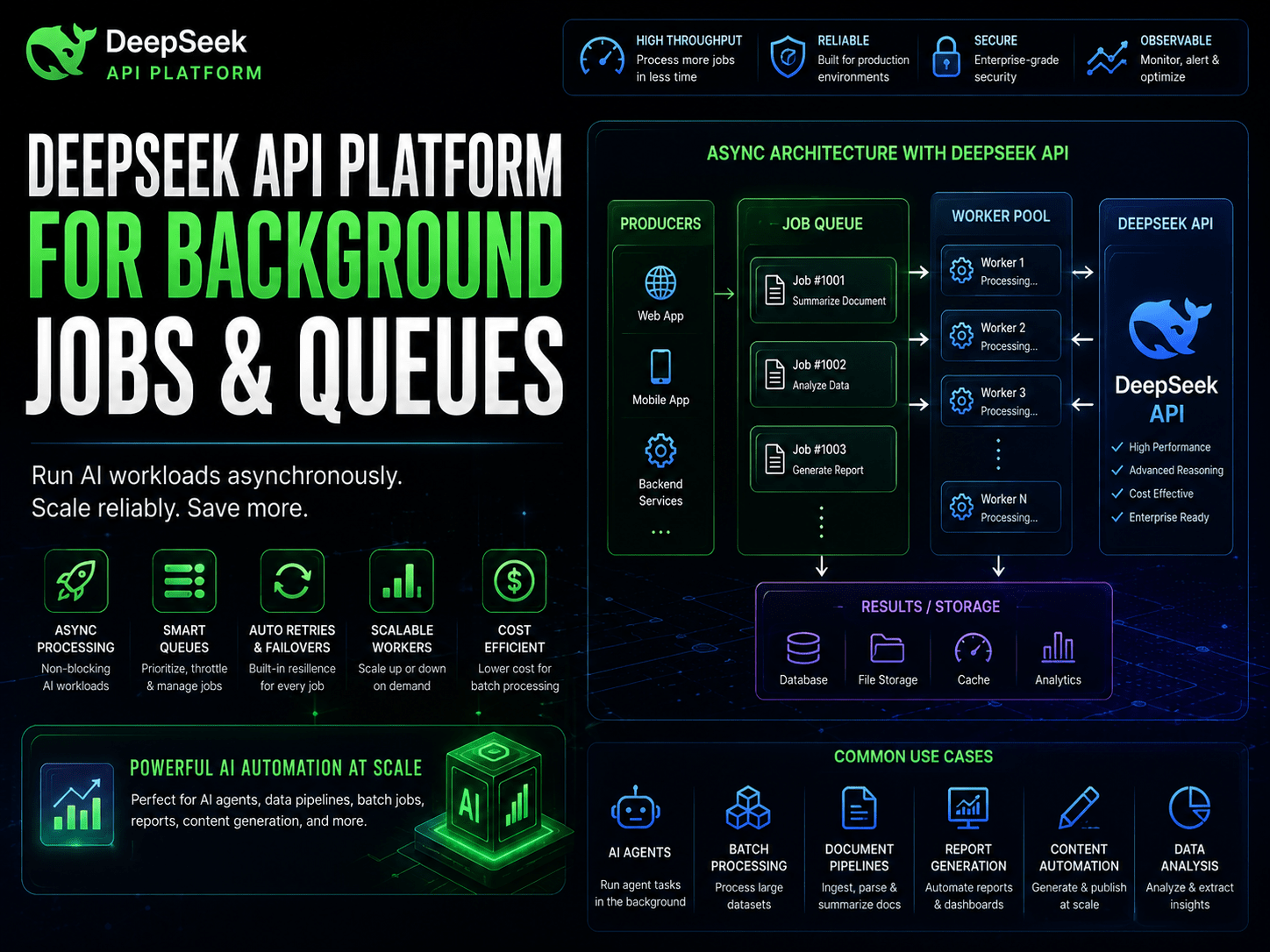
Simple Worker Queue
This is the most common architecture.
Flow:
- Application receives task
- Task enters queue
- Worker consumes queue
- Worker calls DeepSeek API
- Result stored in database
- User notified when complete
This pattern works well for:
- content generation
- summarization
- moderation
- embeddings
- and document analysis
Event-Driven AI Pipelines
In event-driven systems, AI jobs trigger automatically when events occur.
Examples:
- new customer support ticket
- uploaded file
- CRM update
- incoming email
- database change
- Slack event
- webhook event
- or monitoring alert
These systems often use:
- Kafka
- RabbitMQ
- Redis queues
- AWS SQS
- Google Pub/Sub
- BullMQ
- Celery
- or Temporal workflows
DeepSeek integrates naturally into these pipelines because AI processing becomes just another asynchronous worker task.
Batch Processing Systems
Batch processing is one of the strongest use cases for DeepSeek.
Examples include:
- summarizing thousands of support tickets
- analyzing large datasets
- generating embeddings
- processing PDFs
- cleaning structured data
- or evaluating large document collections
Because DeepSeek pricing is often lower than premium enterprise AI APIs, large overnight batch jobs become far more financially practical.
This is extremely important for startups and internal business automation systems.
AI Agents and Multi-Step Workflows
AI agents frequently rely on queue systems.
A modern AI agent may:
- retrieve documents
- call external tools
- analyze responses
- generate reasoning chains
- schedule follow-up tasks
- and orchestrate multiple sub-agents
This creates asynchronous execution patterns naturally.
DeepSeek’s reasoning-focused models can work well for:
- planning systems
- orchestration logic
- chained reasoning
- and workflow automation
But without queues, these architectures quickly become unstable.
Popular Queue Technologies for DeepSeek Workloads
Redis Queues
Redis-based systems are extremely popular because they are:
- fast
- lightweight
- scalable
- and developer-friendly
Common tools include:
- BullMQ
- Sidekiq
- RQ
- Celery with Redis
These work well for medium-scale AI workloads.
RabbitMQ
RabbitMQ provides:
- durable messaging
- routing flexibility
- acknowledgement systems
- and enterprise reliability
It works well for more complex distributed systems.
Kafka
Kafka is commonly used for:
- very large event streams
- enterprise-scale pipelines
- high-throughput architectures
- and streaming AI systems
Kafka becomes useful once AI systems process massive volumes continuously.
Temporal
Temporal is increasingly popular for AI orchestration.
It handles:
- retries
- workflow state
- long-running tasks
- distributed execution
- and failure recovery
This is particularly useful for AI agents and multi-step reasoning systems.
Retry Strategies for DeepSeek API Jobs
Retries are critical in asynchronous systems.
AI APIs occasionally experience:
- timeouts
- transient failures
- rate limits
- invalid responses
- partial outages
- or network issues
Background workers should never retry infinitely.
Good retry systems typically include:
- exponential backoff
- retry limits
- dead-letter queues
- failure logging
- circuit breakers
- and idempotency handling
Rate Limiting Considerations
Queue systems can accidentally overwhelm APIs.
If hundreds of workers send requests simultaneously, rate limits may trigger quickly.
Good DeepSeek queue systems include:
- concurrency control
- token budgeting
- request throttling
- adaptive worker scaling
- and queue prioritization
Without these protections, systems become unstable.
Queue Prioritization Strategies
Not all AI jobs are equally important.
For example:
- customer-facing requests may require immediate processing
- analytics tasks may wait hours
- embeddings jobs may run overnight
- and reporting systems may process during low traffic windows
Good queue systems separate workloads into:
- high priority
- medium priority
- low priority
- scheduled queues
- and retry queues
This improves both reliability and cost management.
Cost Optimization With DeepSeek Queues
One reason developers choose DeepSeek is cost efficiency at scale.
However, poor queue architecture can still waste enormous amounts of money.
Common Cost Mistakes
Over-Retrying Failed Jobs
Repeated failed requests can multiply costs rapidly.
Processing Unnecessary Context
Large prompts dramatically increase token usage.
Poor Queue Deduplication
Duplicate jobs may process the same content repeatedly.
Uncontrolled Concurrency
Aggressive scaling can generate huge token bills unexpectedly.
DeepSeek for Large-Scale Automation
Many organizations now use AI for internal automation.
Examples include:
- report generation
- compliance review
- document tagging
- ticket classification
- sales intelligence
- and workflow enrichment
These systems often process:
- tens of thousands
- hundreds of thousands
- or millions of tasks
Cost efficiency becomes critical.
DeepSeek’s pricing can make large-scale automation economically realistic where premium AI APIs become difficult to justify.
Monitoring and Observability
AI queue systems require strong monitoring.
Important metrics include:
- queue length
- worker throughput
- retry frequency
- token consumption
- latency
- failure rate
- API response times
- and cost per task
Without observability, AI systems become difficult to debug.
Logging Best Practices
Every DeepSeek worker should log:
- request metadata
- response metadata
- processing duration
- retry count
- token usage
- and failure reasons
These logs become essential for:
- debugging
- optimization
- auditing
- and cost management
Horizontal Scaling
One advantage of queue-based systems is horizontal scalability.
When workloads increase, organizations can:
- add more workers
- distribute jobs across regions
- separate workloads by queue
- or isolate specialized AI processing clusters
This flexibility is essential for production AI systems.
Failure Isolation
Good queue architectures isolate failures.
For example:
- embeddings jobs should not block customer-facing tasks
- reporting pipelines should not break support automation
- and analytics workloads should not overload real-time systems
Separate queues improve resilience dramatically.
Security Considerations
AI queue systems often process sensitive data.
Organizations should consider:
- encryption
- access controls
- audit logging
- secure secrets management
- prompt sanitization
- and data retention policies
Background workers sometimes become overlooked attack surfaces.
DeepSeek vs Enterprise AI APIs for Queue Systems
DeepSeek is especially attractive when:
- workloads are high-volume
- token usage is large
- experimentation speed matters
- AI agents generate many requests
- or startups need cost control
Enterprise AI platforms may still provide stronger:
- governance
- compliance tooling
- enterprise controls
- and ecosystem integrations
The right choice depends heavily on operational priorities.
Common Mistakes in AI Queue Architectures
Mistake 1: Treating AI Calls Like Normal APIs
AI responses are probabilistic and slower.
Systems must account for variability.
Mistake 2: No Retry Strategy
Transient failures are normal.
Without retries, systems become unreliable.
Mistake 3: No Queue Prioritization
Critical jobs may become blocked by low-value workloads.
Mistake 4: Poor Cost Visibility
AI workloads can scale costs unexpectedly.
Mistake 5: Ignoring Context Size
Long prompts massively increase operational cost.
When DeepSeek Is a Strong Choice
DeepSeek API Platform is especially strong for:
- AI automation systems
- asynchronous pipelines
- batch processing
- AI agents
- reasoning-heavy workflows
- startup-scale AI products
- and cost-sensitive AI infrastructure
It becomes particularly attractive once workloads scale beyond small prototypes.
Final Verdict
Background jobs and queue systems are foundational for modern AI infrastructure.
Without asynchronous processing, most large-scale AI systems become:
- unstable
- expensive
- difficult to scale
- and operationally fragile
DeepSeek API Platform works especially well in these architectures because:
- scaling costs are more manageable
- high-volume processing becomes practical
- AI agents become economically realistic
- and long-running AI workflows are easier to support financially
For startups, automation systems, internal tooling, and large-scale AI pipelines, DeepSeek can provide a compelling balance between:
- capability
- scalability
- flexibility
- and operational cost efficiency
As AI workloads continue moving toward autonomous workflows and distributed AI systems, queue-based architectures will become even more important.
And platforms that make large-scale asynchronous AI affordable will likely become increasingly attractive to developers building the next generation of AI-powered infrastructure.
FAQs
What are background jobs in AI systems?
Background jobs are asynchronous tasks processed outside the main application request cycle. They help AI systems handle long-running operations like document analysis, summarization, and AI agent workflows without blocking users.
Why use queues with the DeepSeek API Platform?
Queues help manage AI workloads efficiently by controlling concurrency, handling retries, smoothing traffic spikes, and improving scalability for high-volume AI processing systems.
Which queue systems work well with DeepSeek?
Popular queue systems include Redis queues, BullMQ, Celery, RabbitMQ, Kafka, AWS SQS, Google Pub/Sub, and Temporal workflows.
Is DeepSeek good for AI agents and automation workflows?
Yes. DeepSeek is often attractive for AI agents and automation systems because reasoning-heavy workloads become more affordable at scale compared to some premium AI APIs.
How do retries work in DeepSeek queue systems?
Most production systems use retry strategies like exponential backoff, retry limits, dead-letter queues, and circuit breakers to safely recover from temporary API failures.
Can DeepSeek handle batch AI processing?
Yes. DeepSeek works well for batch workloads like summarization pipelines, document ingestion, analytics processing, embeddings generation, and large-scale classification systems.
Why is asynchronous AI processing important?
Async processing improves reliability, scalability, and user experience by moving expensive AI tasks into background workers instead of blocking frontend systems.
How can developers reduce AI queue processing costs?
Developers can reduce costs by limiting retries, optimizing prompt size, controlling concurrency, deduplicating jobs, and monitoring token consumption closely.
What monitoring metrics matter for AI queue systems?
Important metrics include queue length, worker throughput, retry rate, token usage, latency, API failures, and overall processing cost per task.
Is DeepSeek suitable for enterprise automation systems?
DeepSeek can work well for enterprise automation, especially for cost-sensitive large-scale workflows, though some organizations may still require enterprise governance and compliance tooling from larger cloud ecosystems.