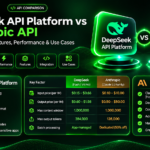
Choosing an AI API is no longer just about finding a model that can answer questions or generate code. Developers and businesses need to consider pricing, reasoning capabilities, context windows, integration options, reliability, scalability, and the total cost of running an application.
Two platforms worth comparing are the DeepSeek API Platform and the Anthropic API.
Both provide access to powerful language models, support advanced application workflows, and offer features designed for developers building AI-powered products. However, they take different approaches to pricing, model availability, API compatibility, and enterprise-oriented features.
DeepSeek has become particularly interesting for developers looking to reduce inference costs without abandoning advanced language-model capabilities. Anthropic, meanwhile, offers the Claude model family, a mature API ecosystem, dedicated batch processing, prompt caching, and tools designed for sophisticated production applications.
There is another important development: DeepSeek now supports the Anthropic API format. This means developers can use the Anthropic SDK to communicate with DeepSeek models by changing the API configuration. It creates an interesting migration path for applications already built around Anthropic-compatible tooling.
So, which platform should you choose?
In this guide, we compare the DeepSeek API Platform vs Anthropic API across pricing, models, features, developer experience, performance considerations, and real-world use cases. We will also explain when using both platforms together makes more sense than choosing only one.
DeepSeek API Platform vs Anthropic API: Pricing, Models, Features & Which Should You Choose?
1. What Are the DeepSeek API Platform and Anthropic API?
Before comparing prices and technical features, it is important to understand what each platform provides.
What Is the DeepSeek API Platform?
The DeepSeek API Platform is the developer-facing service for accessing models developed by DeepSeek.
It allows developers to integrate DeepSeek models into applications, websites, automation systems, chatbots, data pipelines, and AI agents.
The platform provides API access, developer documentation, API key management, usage-based billing, and model-specific configuration options.
Its current model lineup includes:
- DeepSeek Flash: Designed for fast, cost-efficient general-purpose tasks, agent workflows, and other high-volume applications.
- DeepSeek V4 Pro: Designed for more demanding reasoning, coding, and complex analytical workloads.
Both models support thinking and non-thinking modes, allowing developers to configure how the model approaches different tasks.
The DeepSeek API also supports JSON output, tool calls, streaming, and API compatibility options.
One particularly useful feature is its support for the Anthropic API format, which allows developers to access DeepSeek models through Anthropic-compatible SDKs and request structures.
Official developer documentation: https://api-docs.deepseek.com/
What Can You Build With the DeepSeek API Platform
What Is the Anthropic API?
The Anthropic API provides developer access to Anthropic’s Claude family of AI models.
Anthropic is known for developing Claude models used for writing, coding, research, document analysis, reasoning, and agent-based workflows.
Its API allows developers to integrate Claude into applications using the Messages API, streaming responses, tool use, prompt caching, and batch processing.
The current Claude model lineup includes:
- Claude Haiku 5.5: Designed for fast, high-volume tasks such as classification, extraction, and routing.
- Claude Sonnet 5.5: Designed to balance speed, intelligence, and general-purpose capabilities.
- Claude Opus 5.5: Designed for demanding coding, knowledge work, and longer-running agentic workflows.
- Claude Fable 5.1: Designed for demanding reasoning and long-horizon agentic work.
Anthropic also offers additional models and specialized features through its API ecosystem.
Official developer documentation: https://platform.claude.com/docs/
Common API Errors and How to Solve Them (The DeepSeek Guide)
The Main Difference
The simplest distinction is this:
DeepSeek focuses on providing capable AI models with highly competitive token pricing and flexible API integration.
Anthropic offers the Claude ecosystem, with a broad range of models, dedicated batch processing, prompt caching controls, and a mature developer platform.
Neither platform is automatically the best choice for every application. The right decision depends on the workload, required quality, integration requirements, and budget.
Why Our API Platform is the Most Scalable Solution for Your Startup
2. DeepSeek API vs Anthropic API: Quick Comparison
Here is a high-level comparison of the two platforms.
| Feature | DeepSeek API Platform | Anthropic API |
|---|---|---|
| Model family | DeepSeek V4 | Claude |
| Current general-purpose options | DeepSeek Flash and V4 Pro | Haiku 5.5, Sonnet 5.5, Opus 5.5 |
| Context window | Up to 1 million tokens | Up to 1 million tokens on current flagship models |
| Maximum output | Up to 384K tokens | Up to 128K tokens on current flagship models |
| Input pricing | Very low on Flash | Varies by Claude model |
| Output pricing | Very low on Flash | Varies by Claude model |
| Prompt caching | Automatic context caching | Configurable prompt caching |
| Batch processing | Application-managed batching using published token rates | Dedicated Message Batches API |
| Batch discount | No separate general batch discount listed on the published rate card | 50% discount on eligible Batch API usage |
| API format | OpenAI-compatible and Anthropic-compatible | Native Anthropic Messages API |
| Tool calling | Supported | Supported |
| Streaming | Supported | Supported |
| JSON output | Supported | Structured outputs available on supported models |
| Thinking and reasoning | Thinking and non-thinking modes | Model-dependent adaptive or extended thinking |
| SDK ecosystem | OpenAI and Anthropic-compatible integrations | Official Anthropic SDKs |
| Vision | Supported on DeepSeek Flash | Supported across current Claude models |
| Best starting point | Cost-sensitive applications | Applications requiring Claude-specific capabilities and tooling |
Specifications and pricing can change. Always check the official documentation before making a production decision.
An important detail: matching context-window sizes does not mean the models perform identically. Context capacity describes how much information a model can accept, not how accurately it will understand every document or solve every problem.
3. DeepSeek API vs Anthropic API Pricing
Pricing is one of the biggest reasons developers consider DeepSeek.
Both platforms charge according to model usage, but their pricing structures differ.
DeepSeek publishes separate rates for cached input, uncached input, and output tokens. It also distinguishes between peak and off-peak pricing.
Anthropic publishes per-model input and output prices, with additional pricing for prompt-cache writes, cache reads, and batch processing.
The following comparison uses the published pricing checked on November 7, 2026.
Unlocking Advanced Features: A Deep Dive into the DeepSeek API
DeepSeek API Pricing
DeepSeek currently lists two primary API models.
| Model | Pricing period | Cached input per 1M tokens | Uncached input per 1M tokens | Output per 1M tokens |
|---|---|---|---|---|
| DeepSeek Flash | Off-peak | $0.003 | $0.15 | $0.60 |
| DeepSeek Flash | Peak | $0.006 | $0.30 | $1.20 |
| DeepSeek V4 Pro | Off-peak | $0.022 | $0.66 | $1.98 |
| DeepSeek V4 Pro | Peak | $0.044 | $1.32 | $3.96 |
DeepSeek Flash is particularly attractive for applications that process large numbers of routine requests.
Its published off-peak uncached input rate is $0.15 per million tokens, while output costs $0.60 per million tokens.
DeepSeek V4 Pro costs more but remains competitively priced relative to several premium model options.
DeepSeek’s peak pricing applies during specified weekday UTC periods, excluding Chinese public holidays. Off-peak rates are half the peak rates.
Official pricing: https://api-docs.deepseek.com/quick_start/pricing/
Anthropic API Pricing
Anthropic offers multiple Claude models at different price points.
The following table shows standard API pricing per million tokens.
| Claude model | Input per 1M tokens | Output per 1M tokens |
|---|---|---|
| Claude Haiku 5.5 | $0.10 up to 100K-token prompts; $0.50 above that threshold | $0.50 up to 100K-token prompts; $2.50 above that threshold |
| Claude Sonnet 5.5 | $2.00 | $10.00 |
| Claude Opus 5.5 | $4.00 | $20.00 |
| Claude Fable 5.1 | $10.00 | $50.00 |
These are standard global API rates. Anthropic also offers prompt caching and a 50% discount on eligible input and output usage through its Batch API.
Claude Haiku 5.5 has a special pricing threshold for prompts exceeding 100,000 tokens, so its cost should not be compared using only the lower price.
Official pricing: https://platform.claude.com/docs/en/about-claude/pricing
How Different Are the Costs?
Consider a workload that uses:
- 10 million uncached input tokens.
- 2 million output tokens.
Using DeepSeek Flash at off-peak rates:
| Component | Calculation | Cost |
|---|---|---|
| Input | 10 × $0.15 | $1.50 |
| Output | 2 × $0.60 | $1.20 |
| Total | $2.70 |
Using Claude Sonnet 5.5 at standard rates:
| Component | Calculation | Cost |
|---|---|---|
| Input | 10 × $2.00 | $20.00 |
| Output | 2 × $10.00 | $20.00 |
| Total | $40.00 |
For this particular workload, DeepSeek Flash has a substantially lower token cost.
However, this is a pricing comparison, not a claim that the two models produce identical results.
A fair business comparison must also consider task success rates, response quality, retries, latency, and any additional processing required.
What If You Use Anthropic Batch Processing?
Anthropic offers a dedicated Message Batches API for asynchronous workloads.
The Batch API provides a 50% discount on eligible input and output token usage.
Using the same 10-million-input and 2-million-output example with Claude Sonnet 5.5:
| Component | Standard pricing | Batch pricing |
|---|---|---|
| Input | $20.00 | $10.00 |
| Output | $20.00 | $10.00 |
| Total | $40.00 | $20.00 |
This makes Anthropic considerably more attractive for workloads that do not require immediate responses.
DeepSeek’s published model pricing does not list a separate general-purpose discount simply for submitting ordinary requests in batches. Its off-peak rates and context caching can still reduce costs.
This is an important distinction for businesses processing large datasets. Application-managed queues and a provider-operated Batch API are not necessarily the same thing.
4. Model Performance and Reasoning Capabilities
Price is important, but model quality ultimately determines whether an AI integration is useful.
A model that costs less but produces unreliable results can create additional expenses through retries, manual review, and incorrect decisions.
Both DeepSeek and Anthropic provide models intended for different levels of task complexity.
DeepSeek Flash and V4 Pro
DeepSeek Flash is designed for general-purpose use and cost-efficient workloads.
Potential applications include:
- Customer support automation.
- Document classification.
- Content generation.
- Data extraction.
- Retrieval-augmented generation.
- AI agents.
- Coding assistance.
- Routine analytical tasks.
DeepSeek V4 Pro is positioned for more demanding reasoning and complex problem-solving workloads.
It may be worth evaluating for:
- Advanced code debugging.
- Complex technical analysis.
- Multi-step reasoning.
- Mathematical problem-solving.
- Long-document analysis.
- Sophisticated agent workflows.
Both models support thinking and non-thinking modes, providing flexibility when different tasks require different reasoning approaches.
Claude Haiku, Sonnet, Opus, and Fable
Anthropic’s model lineup offers a more differentiated range of options.
Claude Haiku 5.5
Haiku is designed for speed and high-volume processing.
It is particularly relevant for classification, extraction, routing, and other tasks where latency and cost matter.
Claude Sonnet 5.5
Sonnet is designed as a balance between speed and intelligence.
It is suitable for everyday coding, content generation, document analysis, and agent-based applications.
Claude Opus 5.5
Opus targets more demanding coding and knowledge-work scenarios.
It is worth evaluating when complex tasks require additional capability and the budget supports a higher price per token.
Claude Fable 5.1
Fable is designed for demanding reasoning and long-horizon agentic work.
It is a premium option for specialized workloads where its capabilities justify the additional cost.
Which Platform Produces Better Answers?
There is no honest universal winner.
Model performance depends on the task, prompt structure, evaluation criteria, and model configuration.
For example, one model may perform better on structured extraction while another produces stronger results on a particular coding benchmark.
Developers should run their own evaluations using representative production tasks.
A useful evaluation dataset should include:
- Common requests.
- Difficult edge cases.
- Ambiguous instructions.
- Long documents.
- Complex reasoning problems.
- Structured-output requirements.
- Requests requiring tool use.
- Cases where the model should refuse or request clarification.
Measure accuracy, completeness, consistency, latency, and cost per successful task.
This provides more useful information than relying on a single benchmark or a model’s marketing description.
5. Context Windows and Long-Document Processing
Context windows determine how much information a model can process within a request.
Both DeepSeek and current Claude flagship models offer context windows of up to one million tokens.
This is useful for applications involving:
- Long research documents.
- Large codebases.
- Legal and business documentation.
- Technical specifications.
- Knowledge-base search.
- Long conversation histories.
- Multi-document analysis.
However, a large context window does not mean every request should include a million tokens.
Sending unnecessary information increases input usage and can make it harder to identify relevant details.
DeepSeek Context Capabilities
DeepSeek’s current models support a context length of up to one million tokens.
The published maximum output is up to 384K tokens, subject to the model and request configuration.
This provides considerable flexibility for applications that generate long responses or process substantial amounts of information.
Anthropic Context Capabilities
The current Claude flagship lineup also supports context windows of up to one million tokens, with a published maximum output of 128K tokens.
This can be useful for complex document analysis, extended coding tasks, and applications that maintain substantial conversation context.
Which Is Better for Large Documents?
The answer depends on what you need to do with the documents.
If your application needs to process long inputs and generate large outputs, DeepSeek’s published output capacity may be attractive.
If your application relies on Claude-specific workflows, model behavior, or other Anthropic platform features, the Claude ecosystem may be more appropriate.
For either platform, test retrieval accuracy and response quality with realistic documents.
A larger context window is a technical capability, not a guarantee of perfect recall or reasoning.
6. API Compatibility and Developer Experience
This is where the comparison becomes especially interesting.
DeepSeek supports both OpenAI-compatible and Anthropic-compatible API formats.
That means developers can access DeepSeek models using familiar SDKs and request structures.
Anthropic, meanwhile, provides its native Messages API and official SDKs for building applications around Claude.
DeepSeek’s OpenAI Compatibility
Many developers already use software built around the OpenAI API format.
DeepSeek supports this format through its API endpoint:
This can simplify migration for applications already using compatible clients.
In many cases, developers can retain much of their existing integration logic and change the API configuration and model name.
DeepSeek’s Anthropic Compatibility
DeepSeek also supports the Anthropic API format through:
https://api.deepseek.com/anthropic
This allows developers to use the Anthropic SDK to access DeepSeek models.
For example, a Python application can use the Anthropic SDK with a different base URL and DeepSeek API key.
Example:
import anthropic

client = anthropic.Anthropic(
    api_key="YOUR_DEEPSEEK_API_KEY",
    base_url="https://api.deepseek.com/anthropic"
)

message = client.messages.create(
    model="deepseek-flash",
    max_tokens=1000,
    messages=[
        {
            "role": "user",
            "content": "Explain how API caching works."
        }
    ]
)

print(message.content)
This example demonstrates the basic integration pattern. Keep API keys in environment variables or a secure secrets manager in production rather than hardcoding them.
Official integration guide: https://api-docs.deepseek.com/guides/anthropic_api/
Does Anthropic Compatibility Mean Full Feature Compatibility?
No.
This distinction matters.
DeepSeek supports the Anthropic API format, but it does not automatically support every Anthropic-specific feature, parameter, beta header, or service.
The DeepSeek compatibility documentation identifies which request fields and features are supported, ignored, or handled differently.
Before migrating an existing Claude application, check:
- Supported request parameters.
- Message and content-block formats.
- Tool-use behavior.
- Thinking-related fields.
- Streaming response structure.
- Prompt-caching behavior.
- File and image handling.
- Unsupported Anthropic-specific features.
An application that uses only basic Messages API functionality may be relatively straightforward to adapt.
An application that depends heavily on specialized Claude features may require more extensive changes.
API compatibility reduces integration friction. It does not eliminate the need for testing.
7. Prompt Caching: DeepSeek vs Anthropic
Prompt caching can reduce repeated input costs when applications send similar instructions or documents across multiple requests.
Both platforms offer caching capabilities, but their implementations and pricing structures differ.
DeepSeek Context Caching
DeepSeek documents disk-based context caching as enabled by default.
When a request contains a matching cached prefix, eligible input tokens can receive the lower cache-hit price.
At the published off-peak rates:
- DeepSeek Flash cached input costs $0.003 per million tokens.
- DeepSeek V4 Pro cached input costs $0.022 per million tokens.
The cache-hit price is substantially lower than the corresponding uncached-input rate.
For applications that repeatedly send the same system instructions, policies, or reference material, this can produce meaningful savings.
Developers should keep reusable prompt prefixes consistent and inspect API usage data to measure actual cache hits.
Anthropic Prompt Caching
Anthropic provides more explicit prompt-caching controls.
Developers can use automatic caching or define explicit cache breakpoints.
The current pricing structure includes:
- Five-minute cache writes.
- One-hour cache writes.
- Lower-priced cache reads.
For example, Claude Sonnet 5.5 has the following published rates per million tokens:
| Operation | Price |
|---|---|
| Standard input | $2.00 |
| Five-minute cache write | $2.50 |
| One-hour cache write | $4.00 |
| Cache read | $0.10 |
The initial cache write costs more than standard input, while subsequent cache reads are substantially cheaper.
The most suitable caching strategy depends on how frequently your application reuses the same context and how long that context remains useful.
Which Caching System Is Better?
DeepSeek offers attractive cached-input pricing and automatic context caching.
Anthropic provides explicit controls and documented cache durations that can be useful for applications requiring more predictable cache management.
For a workload with stable repeated prefixes, both can reduce costs.
Compare the effective cost of the entire request sequence rather than looking only at the cache-hit price.
8. Batch Processing and High-Volume Workloads
Batch processing is useful when an application needs to process many independent requests without requiring an immediate response for every item.
Examples include:
- Large-scale document classification.
- Product catalog enrichment.
- Customer feedback analysis.
- Research summarization.
- Bulk metadata extraction.
- Dataset preparation.
- Automated evaluation workloads.
The two platforms approach this differently.
DeepSeek Batch Processing
Developers can implement batch processing using application-managed queues and controlled API concurrency.
A typical architecture involves:
- Collecting jobs in a queue.
- Preparing individual API requests.
- Processing requests with controlled concurrency.
- Recording usage and results.
- Retrying eligible failures.
- Saving completed outputs.
DeepSeek publishes model-level token pricing and peak/off-peak rates.
Do not assume that ordinary queued requests receive an additional dedicated batch discount. Check the current pricing documentation for any newly introduced batch-specific service or pricing terms.
Anthropic Message Batches API
Anthropic offers a dedicated Message Batches API.
It allows developers to submit multiple Messages API requests for asynchronous processing.
The documented benefits include:
- A 50% discount on eligible input and output usage.
- Processing of up to 100,000 message requests per batch.
- A maximum batch size of 256 MB.
- Asynchronous processing, with many batches completing in less than an hour.
- Results available for up to 29 days.
Batches can take up to 24 hours to complete, and they may expire if processing does not finish within that period.
There are also limitations around streaming, Fast mode, and certain request parameters.
Another important consideration is data retention: Anthropic’s Batch API stores request and response data during processing and is not eligible for Zero Data Retention under the documented policy.
Review the current Batch API documentation before using it with sensitive workloads.
Which Is Better for Bulk Processing?
Anthropic has a clear advantage when a workload can use its dedicated Batch API and benefit from the 50% discount.
DeepSeek may be more economical for many workloads even without a dedicated batch discount because its published per-token rates are significantly lower.
The correct comparison depends on the model selected, token distribution, caching, quality requirements, and processing deadlines.
9. Tool Calling and AI Agent Development
Modern AI applications increasingly rely on agents that can interact with external tools.
Examples include:
- Searching databases.
- Calling external APIs.
- Reading documents.
- Executing application functions.
- Retrieving information from knowledge bases.
- Performing multi-step workflows.
Both DeepSeek and Anthropic support tool calling.
However, their broader ecosystems and model behavior may differ.
DeepSeek Tool Calling
DeepSeek supports tool calls through its API.
Developers can define functions and allow the model to decide when to call them.
This is useful for:
- Customer support agents.
- Automated research assistants.
- Database-connected applications.
- Workflow automation.
- AI-powered business tools.
- Coding assistants.
DeepSeek’s support for OpenAI-compatible and Anthropic-compatible formats can also make it easier to integrate with existing development tools.
Anthropic Tool Use
Anthropic provides tool-use functionality through its Messages API.
Developers can define tools, receive tool-use requests, execute the corresponding functions, and return results to Claude.
Anthropic also offers a broader set of documentation and platform features for building agent-based applications.
Claude’s model lineup includes options specifically positioned for demanding agentic coding and long-running knowledge-work tasks.
Which Platform Should You Choose for Agents?
DeepSeek is attractive when token economics and flexible integrations are major priorities.
Anthropic may be a stronger fit when the application relies on Claude-specific capabilities, established agent workflows, or specialized platform features.
In either case, test how the model handles tool selection, invalid arguments, repeated calls, and task completion.
A model that calls tools unnecessarily can increase both API costs and application complexity.
10. Streaming, Structured Outputs, and Developer Features
Production applications often need more than a basic request-and-response API.
Developers may require streaming, structured output, tool calls, and reliable error handling.
Streaming
Both platforms support streaming responses.
Streaming allows an application to display generated content as it becomes available instead of waiting for the complete response.
This is useful for chat interfaces, interactive assistants, and applications where users benefit from seeing progress.
Structured Outputs
DeepSeek supports JSON output for supported models.
This is useful for applications that need predictable data structures, such as:
- Product information extraction.
- Customer ticket classification.
- Invoice processing.
- Database enrichment.
- Automated reporting.
Anthropic also provides structured-output capabilities for supported models and API configurations.
Developers should validate the returned content even when structured output is enabled. Valid JSON does not guarantee that the values are correct.
Error Handling
Both platforms require proper error handling in production.
Your application should account for:
- Authentication failures.
- Invalid request parameters.
- Rate limits.
- Network errors.
- Timeouts.
- Incomplete responses.
- Tool-call failures.
For large workloads, implement retry limits and backoff strategies.
Do not repeatedly resend the same invalid request and expect a different outcome. Computers are very patient, but billing systems are not sentimental.
11. Security, Privacy, and Production Considerations
When choosing an AI API, cost and model quality are only part of the decision.
Businesses also need to understand how API keys, request data, stored results, and access controls are managed.
API Key Management
Both platforms require secure API authentication.
Best practices include:
- Store API keys in environment variables or a secrets manager.
- Never expose API keys in frontend JavaScript.
- Restrict access to production credentials.
- Rotate compromised keys.
- Monitor unusual usage.
- Separate development and production credentials.
An exposed API key can allow unauthorized users to consume your account balance or generate unexpected usage charges.
Data Handling
Review the applicable data-retention and privacy documentation before sending confidential information to either provider.
Pay particular attention to:
- Request and response retention.
- Data usage and training policies.
- Data deletion options.
- Regional processing requirements.
- Workspace and account controls.
- Third-party integrations.
- Batch-processing retention rules.
Do not assume that two APIs using similar request formats have identical data-handling policies.
For sensitive business applications, evaluate the exact service and configuration you intend to use.
Monitoring and Cost Controls
Production applications should monitor:
- Input token consumption.
- Output token consumption.
- Cache-hit rates.
- Request volume.
- Error rates.
- Response latency.
- Cost per successful task.
Set internal usage alerts and spending limits where available.
The objective is to identify unexpected usage before it becomes an expensive surprise.
12. Real-World Use Cases: Which Platform Fits Better?
The best platform depends on the type of application you are building.
Here are practical examples.
Use Case 1: AI Customer Support Chatbot
A customer support chatbot may process thousands of messages daily.
It needs to understand questions, retrieve relevant information, classify requests, and generate useful responses.
DeepSeek advantages:
- Competitive token pricing.
- Flash model for routine requests.
- Context caching for reusable instructions.
- Anthropic and OpenAI-compatible integration options.
Anthropic advantages:
- Multiple Claude models for different complexity levels.
- Claude-specific tool-use capabilities.
- Prompt caching controls.
- Mature documentation for production integrations.
Recommendation: Test DeepSeek Flash for routine support workloads and compare it with Claude Haiku or Sonnet using real support conversations. Choose based on cost per correctly resolved request.
Use Case 2: AI Coding Assistant
A coding assistant may need to understand codebases, explain errors, generate code, and interact with development tools.
DeepSeek advantages:
- Competitive pricing.
- A Pro model for demanding reasoning tasks.
- Flexible API formats.
- Large context capacity.
Anthropic advantages:
- Claude models designed for coding and agentic workflows.
- Strong integration options within the Claude ecosystem.
- Tool-use and agent-oriented documentation.
- Multiple model tiers.
Recommendation: Benchmark both platforms against the actual programming languages, repositories, and debugging tasks your users need. Coding quality is too important to decide based on token prices alone.
Use Case 3: Large-Scale Document Processing
Suppose a business needs to classify 500,000 documents.
The workload is large, and most documents do not need immediate responses.
DeepSeek advantages:
- Very low published Flash token rates.
- Automatic context caching for eligible repeated prefixes.
- Application-managed queues.
- Off-peak pricing.
Anthropic advantages:
- Dedicated Message Batches API.
- 50% discount on eligible token usage.
- Asynchronous processing.
- Support for large batch workloads.
Recommendation: Compare the total cost of a DeepSeek-managed queue against Anthropic’s discounted Batch API. Include retries, output quality, processing time, and infrastructure expenses.
Use Case 4: AI Research Assistant
A research assistant may analyze multiple documents, summarize findings, compare sources, and produce structured reports.
DeepSeek advantages:
- Large context window.
- Competitive model pricing.
- Thinking modes.
- Flexible API integration.
Anthropic advantages:
- Claude model choices for different reasoning requirements.
- Prompt caching.
- Tool-use functionality.
- Dedicated support for advanced agent workflows.
Recommendation: Test both models on realistic research tasks. Measure source accuracy, completeness, reasoning quality, and the cost of producing a usable report.
Use Case 5: SaaS Application With AI Features
A SaaS platform may serve thousands of customers and use AI for content generation, classification, recommendations, and automation.
DeepSeek advantages:
- Lower token costs for many common workloads.
- Multiple model options.
- Compatible API formats.
- Potentially attractive economics at high volume.
Anthropic advantages:
- A differentiated Claude model lineup.
- Dedicated Batch API.
- Prompt caching controls.
- Developer tooling and platform features.
Recommendation: Consider a multi-provider architecture. Use the most economical model that meets the quality requirements of each feature, and maintain a fallback option for tasks that require additional capabilities.
13. Can You Migrate From Anthropic API to DeepSeek?
Yes, in many cases.
DeepSeek’s Anthropic API compatibility makes migration easier for applications already using the Anthropic SDK.
Instead of rewriting the entire integration, developers can often change the API key, base URL, and model name.
Basic Migration Steps
Step 1: Create a DeepSeek API account
Register through the official DeepSeek developer platform and generate an API key.
Step 2: Install the Anthropic SDK
For Python:
pip install anthropicStep 3: Change the API configuration
Use the DeepSeek Anthropic-compatible endpoint:
https://api.deepseek.com/anthropicStep 4: Change the model name
For example:
model="deepseek-flash"Step 5: Test existing requests
Check:
- System instructions.
- Message formatting.
- Tool definitions.
- Streaming.
- Thinking-related behavior.
- Token limits.
- Error handling.
- Response parsing.
Step 6: Run a production evaluation
Compare the results against your existing Claude integration.
Measure quality, latency, cost, and failure rates.
What Might Need Modification?
Some Anthropic-specific features and parameters may not be supported by DeepSeek.
Applications that depend on advanced Claude functionality may need code changes.
For this reason, do not assume that changing the base URL automatically creates a complete replacement for Anthropic.
Review the official DeepSeek compatibility guide and test the exact features your application uses.
14. Should You Use DeepSeek, Anthropic, or Both?
There is no reason to treat this as a permanent either-or decision.
A multi-provider architecture can give developers more flexibility.
For example:
| Application task | Possible provider strategy |
|---|---|
| Routine text classification | DeepSeek Flash |
| Basic extraction | DeepSeek Flash |
| High-volume summarization | Benchmark DeepSeek Flash and Claude Haiku |
| Complex coding | Benchmark DeepSeek V4 Pro and Claude Opus |
| Specialized Claude workflow | Anthropic API |
| Cost-sensitive background processing | Compare DeepSeek off-peak usage with Anthropic Batch API |
| Critical application workflow | Use the provider that passes quality and reliability evaluations |
A routing layer can select the appropriate provider based on task complexity, cost limits, and required capabilities.
For example, a SaaS application might use DeepSeek Flash for most requests and route difficult tasks to Claude Sonnet or another validated model.
However, multi-provider systems introduce additional complexity.
You need to manage:
- Multiple API credentials.
- Different request and response formats.
- Provider-specific errors.
- Different caching mechanisms.
- Separate billing systems.
- Model-specific behavior.
- Consistent evaluation and monitoring.
The additional complexity is worthwhile only when it creates measurable value.
15. Final Verdict: DeepSeek API Platform vs Anthropic API
The DeepSeek API Platform and Anthropic API are both capable choices for developers building modern AI applications, but they offer different strengths.
DeepSeek is particularly attractive when cost efficiency is a major priority.
Its Flash model has very competitive published token pricing, its Pro model provides another option for more demanding workloads, and its support for Anthropic-compatible requests creates a practical integration path for existing applications.
Anthropic is attractive when developers want the Claude model ecosystem, dedicated Message Batches API, configurable prompt caching, and Claude-specific features for advanced agentic workflows.
Choose DeepSeek if:
- API cost is a major consideration.
- Your application processes large volumes of requests.
- You want flexible OpenAI and Anthropic-compatible integration.
- You need cost-efficient classification, extraction, or summarization.
- You want to evaluate thinking and non-thinking modes.
- Your application benefits from competitive off-peak pricing.
Choose Anthropic if:
- Your application depends on Claude-specific capabilities.
- You need the dedicated Message Batches API.
- You want explicit prompt-caching controls.
- Your evaluations favor a particular Claude model.
- You rely on Anthropic’s developer ecosystem and production features.
- Your business requirements justify its pricing.
Consider Both if:
- You operate a high-volume SaaS platform.
- Different tasks require different model capabilities.
- You want to optimize cost per successful request.
- You need provider flexibility.
- You can support multi-provider monitoring and routing.
The smartest approach is to benchmark both platforms using your actual workload.
Compare quality, cost, latency, reliability, and integration effort. Then choose the provider that delivers the best overall result for each application feature.
A low token price is valuable, but a reliable AI product needs more than inexpensive inference. It needs models that solve the right problems, integrations that work consistently, and a cost structure that makes business sense.
For many developers, DeepSeek is worth serious consideration as a cost-efficient alternative or complementary provider to Anthropic. And thanks to its Anthropic-compatible API format, evaluating that alternative is easier than it used to be.
Frequently Asked Questions
1. Is DeepSeek API cheaper than Anthropic API?
Generally, DeepSeek Flash has significantly lower published token prices than Anthropic’s current Claude models. For example, DeepSeek Flash off-peak uncached input costs $0.15 per million tokens, while Claude Sonnet 5.5 standard input costs $2.00 per million tokens. Actual total costs depend on model selection, caching, batch discounts, output usage, and workload requirements.
2. Can I use the Anthropic SDK with DeepSeek?
Yes. DeepSeek supports the Anthropic API format through https://api.deepseek.com/anthropic. Developers can use the Anthropic SDK by changing the base URL, API key, and model name. However, not every Anthropic-specific feature or parameter is necessarily supported.
3. Which is better for coding, DeepSeek or Anthropic?
Both platforms offer models suitable for coding tasks. DeepSeek V4 Pro and Claude Opus 5.5 are worth evaluating for complex programming and reasoning workloads, while other models may be sufficient for routine code generation. Benchmark both using your actual repositories, languages, and development tasks before deciding.
4. Does DeepSeek have the same context window as Claude?
The current DeepSeek Flash and V4 Pro models support context windows of up to one million tokens. Current Claude flagship models also support up to one million tokens. Their maximum output limits differ, and matching context sizes do not guarantee identical performance.
5. Does Anthropic offer better batch processing than DeepSeek?
Anthropic offers a dedicated Message Batches API with a 50% discount on eligible input and output token usage. DeepSeek supports application-managed batch processing using its published model pricing, but its general pricing page does not list a separate discount simply for submitting requests in batches. Anthropic has a clearer dedicated batch-processing offering.
6. Does DeepSeek support prompt caching?
Yes. DeepSeek documents automatic disk-based context caching. Eligible repeated input prefixes can receive lower cached-input pricing. Developers should keep stable prompt prefixes consistent and inspect usage data to measure actual cache hits.
7. Which API is better for building AI agents?
Both platforms support tool calling and agent-based workflows. DeepSeek offers competitive pricing and flexible API compatibility. Anthropic offers Claude models designed for demanding agentic tasks and a broad set of developer resources. The better choice depends on tool-use reliability, reasoning quality, cost, and the application’s requirements.
8. Can I switch from Anthropic to DeepSeek without rewriting my application?
In many cases, yes. DeepSeek’s Anthropic-compatible endpoint allows developers to reuse the Anthropic SDK for supported functionality. However, applications relying on Anthropic-specific features may require modifications. Always test request parameters, tool use, streaming, caching, and response handling.
9. Is DeepSeek suitable for production applications?
DeepSeek can be used for production AI applications, including chatbots, automation systems, data processing, and agent workflows. Developers should implement secure API key management, error handling, usage monitoring, validation, and appropriate data-handling controls.
10. Should businesses use DeepSeek and Anthropic together?
They can. A multi-provider architecture can route routine tasks to a lower-cost model and reserve another provider for workloads requiring specific capabilities. This approach can improve cost flexibility, but it also introduces additional integration and monitoring requirements.