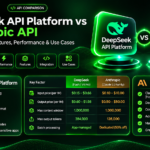
DeepSeek or OpenAI? Which AI should you actually use?
The answer depends on what you want to accomplish.
DeepSeek has established itself as a serious competitor through its reasoning models, open-weight releases, developer-friendly API, and competitive inference costs. OpenAI, meanwhile, offers a broader AI ecosystem combining powerful GPT models with advanced research tools, image generation, voice interactions, data analysis, and agentic workflows.
With DeepSeek’s V4.1-Flash and OpenAI’s GPT-6 generation, the comparison has become more interesting than simply asking which chatbot produces better answers.
For developers, DeepSeek can be an attractive option for building cost-conscious AI applications and experimenting with open-weight models. For professionals, businesses, researchers, and everyday users who need an integrated AI assistant, OpenAI offers a more comprehensive collection of tools.
But there isn’t one universal winner.
In this comparison, we’ll examine DeepSeek vs OpenAI across practical use cases, including programming, writing, research, education, business automation, API development, privacy, and overall value.
The goal isn’t to declare one company the winner of everything. It’s to help you choose the AI platform that makes the most sense for your actual requirements.
DeepSeek vs OpenAI: Final Verdict by Use Case (2026)
DeepSeek vs OpenAI (2025): The Honest Benchmark — Cost, Speed, and Accuracy Face-Off
DeepSeek vs OpenAI: Quick Comparison
Before examining individual use cases, here’s a snapshot of how the two platforms compare.
| Comparison | DeepSeek | OpenAI |
|---|---|---|
| General AI assistance | Excellent | Excellent |
| Advanced reasoning | Strong | Strong |
| Coding assistance | Excellent | Excellent |
| Content writing | Very good | Excellent |
| Mathematical reasoning | Strong | Strong |
| Research capabilities | DeepSeek Search and reasoning | Web Search and Deep Research |
| Image understanding | Supported by V4.1-Flash | Supported |
| Image generation | Not a comparable built-in strength | Available in ChatGPT |
| Voice capabilities | More limited ecosystem | Advanced voice capabilities |
| Data analysis | Model/API-dependent | Integrated data analysis |
| API development | OpenAI-compatible API | Extensive API ecosystem |
| Open-weight models | Yes | Yes, through gpt-oss |
| Local deployment | Supported for released weights | Supported through gpt-oss |
| Agent development | Growing ecosystem | More extensive integrated tooling |
| Enterprise ecosystem | Developing | More established |
| Best overall strength | Open-weight AI and efficient model deployment | Integrated AI platform and productivity tools |
One important distinction: DeepSeek is not just a chatbot, and OpenAI is not just ChatGPT. Both companies offer models, APIs, and additional tools. Comparing their complete ecosystems provides a more useful picture than comparing two chat windows.
DeepSeek vs OpenAI: Understanding the Latest Models
Model comparisons become outdated quickly. A conclusion based on an older model can become misleading after a major release.
Let’s look at the current generation.
DeepSeek’s Latest Models
DeepSeek’s current API documentation identifies two important model options:
DeepSeek-V4.1-Flash
The current API model identifier is deepseek-flash, which serves DeepSeek-V4.1-Flash-1017.
Its capabilities include:
- Advanced reasoning and thinking modes.
- Native visual understanding.
- Tool calling and structured outputs.
- A 1-million-token context window.
- Support for the Responses API.
- High-throughput inference.
- Open-weight availability under the MIT license.
DeepSeek designed V4.1-Flash around efficiency and inference performance. It is particularly interesting for developers who need capable models without automatically moving to expensive flagship alternatives.
DeepSeek-V4-Pro
DeepSeek also documents V4-Pro as an available API model with a higher-cost pricing tier.
It is relevant for evaluating demanding reasoning, mathematical, and coding workloads. Developers should check the current API documentation because model routing and availability can change.
OpenAI’s Latest Models
OpenAI’s GPT-6 generation offers several options for different workloads.
| Model | Primary Use |
|---|---|
| GPT-6 Astra | Advanced reasoning, research, complex coding |
| GPT-6.1 Sol | Professional workloads and complex development |
| GPT-6.1 Terra | Visual reasoning, computer use, writing |
| GPT-6 Luna | Efficient, high-volume tasks |
OpenAI’s ecosystem also includes specialized models and services for coding, image generation, voice, and other AI workloads.
Rather than forcing every task through one model, developers and users can select models based on their requirements.
What Does This Mean?
DeepSeek offers a compelling model lineup, particularly for developers interested in open weights and cost-conscious deployment.
OpenAI offers more variety across its integrated AI ecosystem, with models and specialized tools designed for different professional tasks.
Neither company has a permanent advantage. Model updates, pricing changes, and independent evaluations can change the comparison.
DeepSeek vs OpenAI: Which Is Better for Coding?
Verdict: OpenAI for integrated development workflows; DeepSeek for open-weight experimentation and cost-conscious coding applications.
Coding is one of the most important areas where DeepSeek and OpenAI compete.
Both platforms can generate code, explain programming concepts, identify bugs, refactor existing projects, and assist with software architecture.
DeepSeek has made considerable progress in coding-oriented capabilities through its model development and reasoning improvements.
OpenAI takes a broader approach by combining capable reasoning models with development tools, Codex, computer use, and agent-oriented workflows.
Where DeepSeek Performs Well
DeepSeek is worth considering for:
- Generating Python, JavaScript, PHP, and other programming code.
- Explaining unfamiliar codebases.
- Debugging common programming problems.
- Creating functions and reusable components.
- Generating SQL queries.
- Understanding technical documentation.
- Building applications using API integrations.
Its open-weight models also provide developers with more flexibility when they want to experiment with model deployment and customization.
Where OpenAI Has an Advantage
OpenAI provides a broader development environment.
Its ecosystem includes Codex, advanced reasoning models, tool calling, computer use, and integrations that help developers work through more complicated software tasks.
This is especially useful when a development workflow involves more than simply generating code.
For example, building an application might require understanding requirements, inspecting files, modifying code, running tests, identifying errors, and making corrections.
An integrated agentic development environment can make that workflow significantly easier.
Final Coding Verdict
Choose DeepSeek when you want a capable model for code generation, experimentation, or budget-conscious API applications.
Choose OpenAI when you need a more comprehensive AI-powered development workflow with advanced tools and agent capabilities.
Developers building production applications should test both against their actual codebase rather than relying on generic benchmark rankings.
DeepSeek vs OpenAI: Which Is Better for Content Writing?
Verdict: OpenAI has the advantage for integrated professional writing workflows. DeepSeek remains a capable alternative for generating and improving written content.
AI writing is no longer limited to generating blog posts.
Professionals use AI to write articles, product descriptions, marketing emails, documentation, social media content, advertisements, and business communications.
Both platforms can help with these tasks, but their broader capabilities differ.
DeepSeek for Content Writing
DeepSeek can assist with:
- Blog post outlines.
- Article drafts.
- Grammar improvements.
- Content summaries.
- Product descriptions.
- Email writing.
- SEO content brainstorming.
- Rewriting and translation.
It can also help users organize complicated information into structured content.
For businesses producing large quantities of relatively straightforward text, DeepSeek can be an attractive option.
However, generating readable text and producing publication-ready content are different things. Human editing, fact-checking, and SEO quality control remain important.
OpenAI for Content Writing
OpenAI offers a more extensive writing and productivity environment.
ChatGPT can help with:
- Long-form content creation.
- Detailed editing and rewriting.
- Tone and style adjustments.
- Document analysis.
- Research-backed writing.
- Marketing strategy.
- File-based content workflows.
- Content planning and organization.
Its ability to combine writing with web research, document uploads, and other tools is particularly useful for professional content teams.
Final Writing Verdict
For straightforward writing and content generation, DeepSeek is a capable alternative.
For content professionals who regularly combine research, writing, editing, document analysis, and creative tasks, OpenAI provides a more complete workflow.
Neither platform should be treated as an automatic replacement for editorial judgment.
DeepSeek vs OpenAI: Which Is Better for Research?
Verdict: OpenAI for comprehensive research workflows; DeepSeek for reasoning and AI-assisted information discovery.
Research requires more than producing a convincing answer.
A useful research assistant needs to locate information, understand sources, compare evidence, identify contradictions, and organize findings.
This is where the broader tool ecosystems become important.
DeepSeek Research Capabilities
DeepSeek provides reasoning capabilities and search functionality through its evolving ecosystem.
Its Search functionality supports information discovery, while its models can help interpret and organize the resulting information.
DeepSeek can be useful for:
- Exploring technical topics.
- Understanding research papers.
- Summarizing information.
- Comparing ideas.
- Organizing research notes.
- Working through mathematical and logical problems.
OpenAI Research Capabilities
OpenAI provides web search and Deep Research capabilities.
Deep Research is designed to investigate complicated questions across multiple online sources and produce structured, cited results.
ChatGPT also combines research with file uploads, data analysis, and other tools.
For example, a business owner researching a new market could ask ChatGPT to investigate competitors, examine uploaded reports, compare pricing information, and organize the findings.
That integrated experience provides a considerable advantage.
Final Research Verdict
OpenAI is the stronger choice when research requires a coordinated workflow involving multiple sources, citations, documents, and data.
DeepSeek is a useful alternative for reasoning, technical exploration, and information processing.
For research involving important decisions, verify the original sources regardless of which AI generates the answer.
DeepSeek vs OpenAI: Which Is Better for Mathematics and Logical Reasoning?
Verdict: Both deserve consideration. The better model depends on the mathematical problem and the quality of its reasoning process.
Mathematics and logical reasoning are important strengths in modern AI models.
DeepSeek has invested heavily in reasoning-focused AI development, while OpenAI continues to develop models designed for complex problem-solving.
Both platforms can help with:
- Algebra and calculus.
- Mathematical explanations.
- Equation solving.
- Probability and statistics.
- Logical puzzles.
- Programming-related mathematics.
- Step-by-step problem analysis.
DeepSeek’s reasoning-focused model development makes it particularly interesting for mathematical experimentation.
OpenAI’s advanced models are also designed for demanding reasoning tasks, making them useful for complicated professional and academic problems.
Which Should Students and Researchers Choose?
For learning mathematical concepts, both platforms are worth trying.
For advanced problems, compare their solutions against verified answers.
An AI model that produces a detailed explanation can still make a mathematical mistake. A long chain of reasoning is not proof of correctness.
DeepSeek vs OpenAI: Which Is Better for Business Automation?
Verdict: OpenAI for comprehensive managed workflows; DeepSeek for custom model deployment and cost-conscious automation.
AI automation is becoming one of the most valuable applications of generative AI.
Businesses are using AI to automate repetitive tasks, analyze information, generate customer responses, process documents, and support internal operations.
Both providers offer technologies that developers can integrate into business applications.
DeepSeek for Business Automation
DeepSeek is worth considering when businesses want to:
- Build custom AI chatbots.
- Automate text-processing tasks.
- Generate structured data.
- Create internal AI assistants.
- Build API-driven applications.
- Experiment with self-hosted models.
Its open-weight releases provide additional flexibility for organizations that want greater control over model deployment.
However, self-hosting does not eliminate infrastructure, security, maintenance, or compliance costs.
OpenAI for Business Automation
OpenAI offers a broader collection of capabilities for integrated automation.
These include:
- Function calling.
- Responses API.
- File and document processing.
- Web search.
- Computer use.
- Agent development tools.
- Specialized models.
This makes OpenAI attractive for businesses building applications that need multiple connected capabilities.
Final Business Verdict
Choose OpenAI when your business needs an integrated ecosystem of models, tools, and managed workflows.
Choose DeepSeek when you prioritize model flexibility, open weights, or cost-conscious custom deployments.
For production systems, evaluate reliability, maintenance, security, support, and actual operating costs before choosing a provider.
DeepSeek vs OpenAI: Which Has Better API Pricing?
Verdict: DeepSeek offers competitive API pricing, but it isn’t automatically cheaper than every OpenAI model.
API pricing is one of DeepSeek’s most important competitive strengths.
However, comparing AI API prices requires looking beyond the price of a single input token.
You need to consider model quality, output token costs, prompt caching, peak pricing, tool usage, and the number of requests your application generates.
Current API Pricing Comparison
The following figures use published API rates available on November 7, 2026.
| Model | Input / 1M Tokens | Output / 1M Tokens |
|---|---|---|
| DeepSeek V4.1-Flash | $0.15 off-peak | $0.60 off-peak |
| DeepSeek V4.1-Flash | $0.30 peak | $1.20 peak |
| GPT-6 Luna | $0.10 | $0.50 |
| GPT-6.1 Terra | $1.00 | $5.00 |
| GPT-6.1 Sol | $2.00 | $10.00 |
| GPT-6 Astra | $10.00 | $50.00 |
All prices are in USD per million tokens. Pricing tiers, context length, processing modes, and additional tool charges can affect the final bill.
DeepSeek also offers reduced cached-input rates. For V4.1-Flash, the off-peak cache-hit input price is $0.003 per million tokens.
Why DeepSeek Can Be Attractive
DeepSeek’s API is particularly interesting for developers who need:
- High-volume text processing.
- AI-powered automation.
- Custom chatbots.
- Large-scale content workflows.
- Open-weight model deployment.
- Applications where inference costs are important.
Why OpenAI Can Still Be Worth the Extra Cost
OpenAI provides additional models and tools that may reduce development complexity.
A more expensive model can sometimes be more economical overall if it requires fewer corrections, fewer external integrations, or less development effort.
For example, a business building a complex research assistant may benefit from OpenAI’s integrated search and computer-use capabilities.
The correct comparison is total cost per successful task, not simply the cheapest token price.
Final Pricing Verdict
DeepSeek is an attractive option for developers optimizing inference costs and exploring open-weight deployment.
OpenAI offers several pricing tiers, including relatively inexpensive models, alongside its more powerful flagship models.
Always calculate your expected monthly usage before committing to either provider.
DeepSeek vs OpenAI: Which Is Better for Open-Source AI and Self-Hosting?
Verdict: Both offer open-weight models, but DeepSeek has a compelling advantage for developers exploring its latest V4.1-Flash release.
This comparison requires an important distinction.
Open-weight models provide downloadable model parameters that developers can run or adapt using supported infrastructure. That is not necessarily the same as having access to every component of the original training process.
DeepSeek has released open-weight models, including V4.1-Flash under the MIT license.
OpenAI has also released its gpt-oss-120b and gpt-oss-20b models under the Apache 2.0 license.
However, OpenAI’s gpt-oss models are separate from its flagship GPT-6 models. They are not served through ChatGPT or the OpenAI API.
Why Developers May Prefer DeepSeek
DeepSeek is attractive to developers who want to:
- Download supported model weights.
- Experiment with local inference.
- Customize AI applications.
- Build applications around open-weight models.
- Explore alternative inference infrastructure.
Why Developers May Prefer OpenAI
OpenAI’s gpt-oss models provide another open-weight option.
The Apache 2.0 license allows broad commercial use, modification, and redistribution, subject to applicable usage policies.
Developers can run these models on their own infrastructure or through compatible hosting providers.
Final Open-Weight Verdict
There is no longer a simple open-versus-closed distinction between the two companies.
Both offer open-weight models.
DeepSeek is particularly interesting for developers exploring its V4 family, while OpenAI’s gpt-oss releases provide a separate open-weight alternative.
For deployment decisions, compare licensing, hardware requirements, inference performance, maintenance needs, and available tooling.
DeepSeek vs OpenAI: Which Is Better for Privacy and Data Security?
Verdict: OpenAI offers more explicit API data-control options, while DeepSeek requires careful consideration of its published data-storage and processing practices.
Privacy should be part of any serious AI platform evaluation.
People regularly submit business documents, customer information, private messages, source code, financial information, and other sensitive material to AI applications.
Before choosing a provider, understand what happens to that information.
DeepSeek Privacy Considerations
DeepSeek’s consumer privacy policy explains that its services can collect:
- User prompts.
- Uploaded files.
- Photos and voice inputs.
- Chat history.
- Account information.
- Device and network information.
Its published policy also states that personal data is processed and stored in China.
The policy provides certain privacy rights and allows users to opt out of specified uses of their personal data, including model training.
Organizations should review the applicable policy and service terms before sending confidential information.
OpenAI Privacy Considerations
OpenAI offers different data-handling arrangements depending on the product and account type.
For individual ChatGPT accounts, model improvement can be controlled through available data settings.
OpenAI also states that data submitted through its API is not used to train or improve its models by default, unless the customer explicitly opts in.
API abuse-monitoring logs may be retained for up to 30 days by default, subject to applicable exceptions and available controls.
Business and enterprise products have additional data-handling arrangements.
Final Privacy Verdict
For organizations building commercial applications, OpenAI’s API data-handling arrangements provide an attractive starting point.
DeepSeek may also be suitable for particular applications, but its published data-storage practices and jurisdiction should be considered carefully.
Neither provider should automatically receive confidential information simply because it offers an impressive AI model.
Businesses should evaluate applicable contracts, regulatory obligations, data residency, retention, and security requirements before deployment.
DeepSeek vs OpenAI: Which Is Better for Students and Education?
Verdict: Both are useful learning assistants. OpenAI has an advantage when education requires integrated research, file analysis, and voice capabilities.
Students can use AI to understand complicated subjects, practice problems, summarize educational material, and explore unfamiliar topics.
DeepSeek can help with:
- Explaining technical concepts.
- Solving practice problems.
- Understanding mathematics.
- Learning programming.
- Summarizing study material.
- Exploring scientific topics.
OpenAI provides similar educational support, with additional capabilities such as file analysis, web research, and voice-based interactions.
For example, students can upload course materials, ask questions about specific sections, and use data analysis tools where appropriate.
Final Education Verdict
DeepSeek is a capable learning companion, particularly for reasoning and technical explanations.
OpenAI is the more comprehensive educational assistant for students who want research, documents, voice, and other productivity features in one environment.
Neither should replace textbooks, primary sources, or proper academic research.
DeepSeek vs OpenAI: Which Is Better for Everyday Users?
Verdict: OpenAI for an all-in-one assistant; DeepSeek for users who primarily want text-based AI assistance and reasoning.
Not everyone needs an API, a coding agent, or an advanced reasoning model.
Many people simply want help answering questions, writing messages, translating text, understanding complicated topics, and organizing everyday tasks.
Both DeepSeek and ChatGPT are capable of handling these activities.
However, ChatGPT provides a wider selection of integrated features, depending on the user’s subscription and availability.
These include image generation, image understanding, voice, web search, data analysis, file uploads, and Deep Research.
DeepSeek remains an interesting choice for users who primarily need conversational assistance, reasoning, and information processing.
Final Everyday User Verdict
For people who want one AI assistant that can handle a broad range of digital tasks, OpenAI is the stronger choice.
For people interested primarily in conversational AI and reasoning, DeepSeek is a worthwhile alternative.
DeepSeek vs OpenAI: Final Verdict by Use Case
We’ve examined the major categories. Now let’s make the decision easier.
Here is the practical recommendation for different types of users.
| User Type | Recommended Platform | Main Reason |
|---|---|---|
| Software developers | Depends on workflow | DeepSeek for open-weight experimentation; OpenAI for integrated coding agents |
| AI researchers | Both | Different strengths in reasoning, models, and tools |
| Content writers | OpenAI | More comprehensive research and writing workflow |
| SEO professionals | OpenAI | Strong integrated research and content tools |
| Students | Both | Good learning and problem-solving capabilities |
| Mathematics enthusiasts | Both | Compare models on specific problems |
| SaaS developers | DeepSeek | Interesting open-weight and API deployment options |
| Enterprise businesses | OpenAI | Broader managed tooling and data-control options |
| AI automation developers | OpenAI | More extensive integrated tool ecosystem |
| Budget-conscious developers | Depends on model | Compare actual workload pricing |
| Local AI enthusiasts | Both | Open-weight deployment options |
| Digital marketers | OpenAI | Broader combination of research, writing, and creative tools |
| Everyday users | OpenAI | More comprehensive assistant experience |
Our Overall Recommendation
Rather than choosing a winner based on brand reputation, consider what you actually need from an AI platform.
Choose DeepSeek when:
- You want to experiment with open-weight models.
- You are building custom AI applications.
- You want an additional API provider.
- You prioritize inference efficiency.
- You want flexibility around model deployment.
- Your main activities involve reasoning, coding, and text processing.
Choose OpenAI when:
- You need a comprehensive AI assistant.
- You regularly perform online research.
- You work with documents and spreadsheets.
- You need image generation and advanced voice capabilities.
- You build complex agentic workflows.
- You want integrated tools for professional productivity.
Consider using both when:
- You operate multiple AI-powered applications.
- You want to compare model outputs.
- You need alternative API providers.
- You want to optimize infrastructure costs.
- You want to avoid depending entirely on one AI ecosystem.
Using multiple AI providers can be a sensible strategy, provided you manage the additional integration and maintenance requirements.
Frequently Asked Questions
Is DeepSeek better than OpenAI in 2026?
Neither platform is universally better. DeepSeek is particularly attractive for open-weight models and cost-conscious AI development. OpenAI offers a broader collection of integrated AI tools, research features, and professional workflows.
Is DeepSeek better than ChatGPT?
DeepSeek can be an excellent alternative for reasoning, coding, and text-based assistance. ChatGPT offers additional capabilities, including advanced research, image generation, voice, and integrated productivity tools.
Which is better for coding, DeepSeek or OpenAI?
Both are capable coding assistants. DeepSeek is worth considering for open-weight deployment and cost-conscious development. OpenAI has an advantage when developers need integrated coding agents and computer-use capabilities.
Which AI has cheaper API pricing?
Pricing depends on the specific models and usage patterns. DeepSeek V4.1-Flash offers competitive API rates, but OpenAI’s GPT-6 Luna is also competitively priced. Compare input, output, caching, and tool costs before deciding.
Can DeepSeek replace ChatGPT?
For many text-based tasks, DeepSeek can replace ChatGPT. However, it does not offer an identical feature set. Users who depend on ChatGPT’s image generation, voice, Deep Research, and other integrated tools may prefer OpenAI.
Does OpenAI have open-source AI models?
OpenAI offers gpt-oss-120b and gpt-oss-20b as open-weight models under the Apache 2.0 license. These models can be deployed on compatible infrastructure but are not available through ChatGPT or the OpenAI API.
Can DeepSeek models run locally?
Yes. DeepSeek publishes downloadable model weights, including V4.1-Flash under the MIT license. Local deployment requires compatible software and sufficient computing infrastructure.
Is DeepSeek safe for business use?
It depends on the application, deployment method, data sensitivity, and applicable compliance requirements. Businesses should review DeepSeek’s current privacy policy, terms, security practices, and data-storage arrangements before using it with confidential information.
Should developers use DeepSeek and OpenAI together?
Yes. Developers can integrate both providers into the same application, assign different workloads to different models, and compare their performance. This can also reduce dependence on a single provider.
Final Verdict: DeepSeek vs OpenAI
DeepSeek and OpenAI are competing in an industry where model capabilities, infrastructure, and available tools continue to evolve.
DeepSeek has demonstrated that powerful AI models do not have to come exclusively from the largest established AI platforms. Its open-weight releases, reasoning capabilities, and developer-focused API make it an important competitor.
OpenAI remains a strong choice for users who want more than a conversational model. Its combination of GPT models, research tools, image generation, coding capabilities, voice, and productivity features creates a broader AI ecosystem.
Our verdict is straightforward:
DeepSeek is an excellent choice for developers seeking open-weight flexibility, efficient model deployment, and capable AI reasoning. OpenAI is the stronger all-around platform for users and businesses that need an integrated AI assistant and a wider range of advanced tools.
However, the smartest decision may not be choosing one company exclusively.
As AI development accelerates, the ability to select the right model for each task could become more valuable than committing to a single provider.
The future of AI is unlikely to belong to just one model or company. It will increasingly belong to people and businesses that know how to use multiple AI systems effectively.
And that may be the most important lesson from the DeepSeek vs OpenAI comparison.