
If you’re building anything even remotely serious on top of DeepSeek, this question eventually hits you:
“How often does DeepSeek actually go down?”
Short answer:
Not frequently, but often enough that you should never ignore it.
Long answer? That’s what this entire breakdown is for.
DeepSeek has rapidly become one of the most widely used AI platforms thanks to models like DeepSeek V3 and DeepSeek R1. But with massive adoption comes a predictable side effect:
Infrastructure strain, occasional outages, and developers quietly questioning their life choices at 2 AM.
This guide breaks down:
- Real DeepSeek uptime trends
- How often outages actually happen
- Major incident history
- What causes downtime
- How reliable DeepSeek is compared to competitors
- What developers should expect in production
📊 DeepSeek Uptime: What the Data Shows
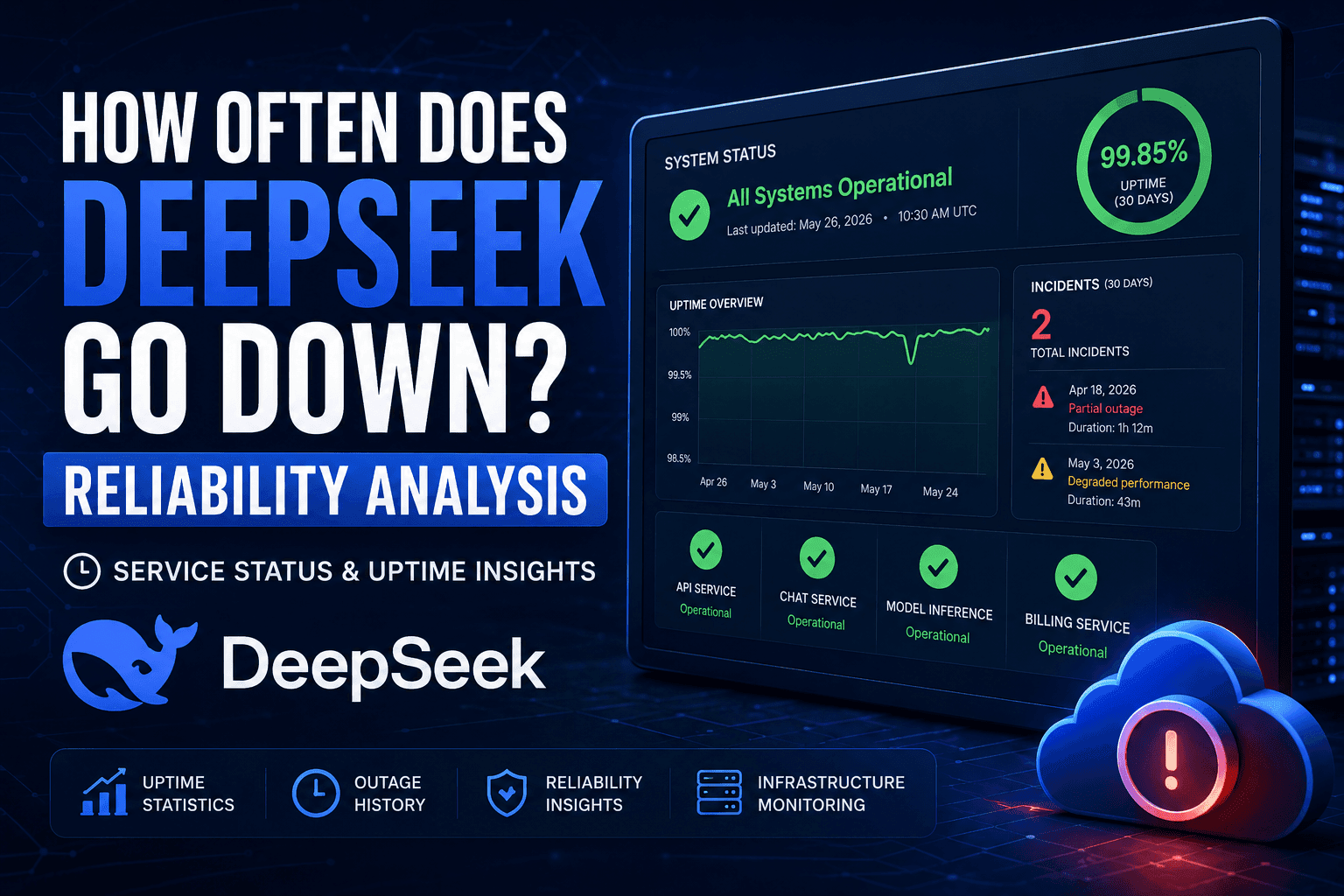
DeepSeek generally maintains:
- ~99% to 99.9% uptime monthly
- Occasional short-lived outages
- Rare but impactful major incidents
What 99% Uptime Actually Means
Let’s translate that into reality:
| Uptime % | Downtime Per Month |
|---|---|
| 99% | ~7.2 hours |
| 99.5% | ~3.6 hours |
| 99.9% | ~43 minutes |
So when a platform says “99% uptime,” what they really mean is:
“We might disappear for several hours and still technically call it reliable.”
📉 How Often Does DeepSeek Go Down?
Typical Frequency
Based on historical patterns:
- Minor issues: Every few weeks
- Moderate incidents: Monthly
- Major outages: Rare (every few months)
Most downtime is:
- Short-lived (minutes to 1 hour)
- Related to traffic spikes
- Quickly resolved
🚨 Major DeepSeek Outages (Real History)
1. March 2026 Major Outage
- Duration: ~7+ hours
- Impact: Global API and chatbot disruption
- Severity: High
This was one of DeepSeek’s longest outages and exposed scaling limitations under heavy load.
2. April 2026 API Incident
- Duration: ~1 hour
- Impact: API request failures
- Severity: Medium
Developers experienced intermittent failures and timeouts.
3. Early 2025 Growth Instability
- Cause: Viral adoption
- Impact:
- Slow responses
- API failures
- Registration restrictions
This phase basically proved one thing:
DeepSeek got popular faster than its infrastructure could keep up.
⚠️ Why DeepSeek Goes Down
1. Massive Traffic Spikes
AI tools don’t scale like normal SaaS apps.
When demand spikes:
- Thousands of requests hit simultaneously
- GPU queues fill up
- Latency skyrockets
2. GPU Infrastructure Limits
DeepSeek relies on:
- High-end GPUs
- Distributed inference systems
- Memory-intensive workloads
Unlike traditional APIs, scaling isn’t just “add more servers.”
It’s more like:
“Find more GPUs in a world where everyone else also wants them.”
3. Model Complexity
Advanced models like reasoning systems require:
- Longer compute cycles
- More memory
- More scheduling coordination
Result:
- Slower responses
- Higher failure probability under load
4. Deployment Issues
New updates can introduce:
- Routing failures
- Model crashes
- API inconsistencies
Every deployment is a gamble dressed up as progress.
5. Cyberattacks
DeepSeek has faced:
- DDoS attempts
- Bot traffic spikes
- Malicious usage patterns
AI platforms are now prime attack targets.
Because of course they are.
6. Infrastructure Failures
Even large systems fail due to:
- Datacenter issues
- Network routing problems
- Hardware crashes
The internet is held together by optimism and redundant cables.
📊 Reliability Compared to Other AI APIs
Let’s put things in perspective.
| Platform | Reliability | Notes |
|---|---|---|
| DeepSeek | High | Fast growth = occasional instability |
| OpenAI | Very High | Mature infrastructure |
| Anthropic | High | Strong but capacity-limited |
| Google Gemini | Very High | Massive scale |
| Open Source (Self-hosted) | Variable | Depends on your setup |
Key Insight:
DeepSeek is reliable, but:
- Not the most stable
- Not the least stable
- Still maturing
🧠 Real-World Reliability Patterns
What Developers Actually Experience
1. Mostly Stable Operation
Most of the time, everything works fine.
2. Sudden Slowdowns
Latency spikes without warning.
3. Intermittent Failures
Some requests succeed, others fail.
4. Rare Full Outages
Entire API becomes unavailable.
⚙️ Signs DeepSeek Is About to Go Down
You can often detect issues early:
- Response time suddenly increases
- Token streaming slows down
- Error rates rise
- Requests start timing out
These are warning signs, not random glitches.
🛠️ How to Handle DeepSeek Downtime
1. Implement Retries
Use:
- Exponential backoff
- Retry limits
- Delay strategies
2. Add Fallback Providers
Never rely on one API.
Use:
- Multiple AI providers
- Backup endpoints
- Failover logic
3. Cache Responses
Reduces dependency on live API calls.
4. Monitor Everything
Track:
- Latency
- Errors
- Request success rate
5. Optimize Prompts
Large prompts increase failure risk.
📈 Is DeepSeek Reliable Enough for Production?
Yes — With Conditions
DeepSeek is reliable if you:
- Expect occasional downtime
- Build fallback systems
- Use proper error handling
No — If You Expect Perfection
If your system requires:
- 100% uptime
- Zero latency spikes
- Guaranteed responses
Then no API on Earth will satisfy you.
🔐 Enterprise Reliability Considerations
For businesses:
- SLA expectations matter
- Redundancy is required
- Monitoring is critical
Never depend on a single AI provider.
🔄 DeepSeek vs Self-Hosting Reliability
DeepSeek API
Pros:
- Easy to use
- Scalable
- Managed infrastructure
Cons:
- External dependency
- Occasional outages
Self-Hosting
Pros:
- Full control
- No external downtime
Cons:
- Expensive
- Complex
- Hard to scale
📊 Future Reliability Outlook
DeepSeek is improving rapidly.
Expect:
- Better uptime
- More infrastructure scaling
- Reduced outage frequency
But also:
- Increased demand
- Continued pressure
❓ FAQ
How often does DeepSeek go down?
DeepSeek experiences minor issues every few weeks and major outages rarely, typically every few months.
Is DeepSeek reliable?
Yes, with ~99% uptime, but occasional downtime occurs.
What causes DeepSeek outages?
Traffic spikes, GPU limits, bugs, and infrastructure failures.
How long do outages last?
Most last minutes to an hour, but rare cases can exceed several hours.
Can I prevent downtime issues?
You can’t prevent them, but you can mitigate them using retries and fallback systems.
🏁 Final Verdict
DeepSeek is a highly capable but still maturing AI platform.
It does not go down frequently enough to avoid using it.
But it does go down often enough that ignoring reliability would be… optimistic at best.
The smartest approach is simple:
Assume it will fail occasionally and design your system accordingly.
Because in modern AI infrastructure, uptime is less about guarantees and more about how gracefully you handle the moment everything stops working. 😌